
Home-Based Brain Stimulation in Mild Cognitive Impairment

How Caregivers Are Transforming Cognitive Therapy at Home
The management of mild cognitive impairment (MCI) is entering a new era—one that extends beyond clinics and into patients’ homes. Emerging evidence suggests that caregiver-administered transcranial alternating current stimulation (tACS) may offer a scalable, safe, and practical solution for delivering repeated neuromodulation therapy.
For both clinicians and caregivers, this shift represents a critical opportunity to improve treatment adherence, accessibility, and long-term cognitive outcomes.
What Is Home-Based Brain Stimulation (Home-tACS)?
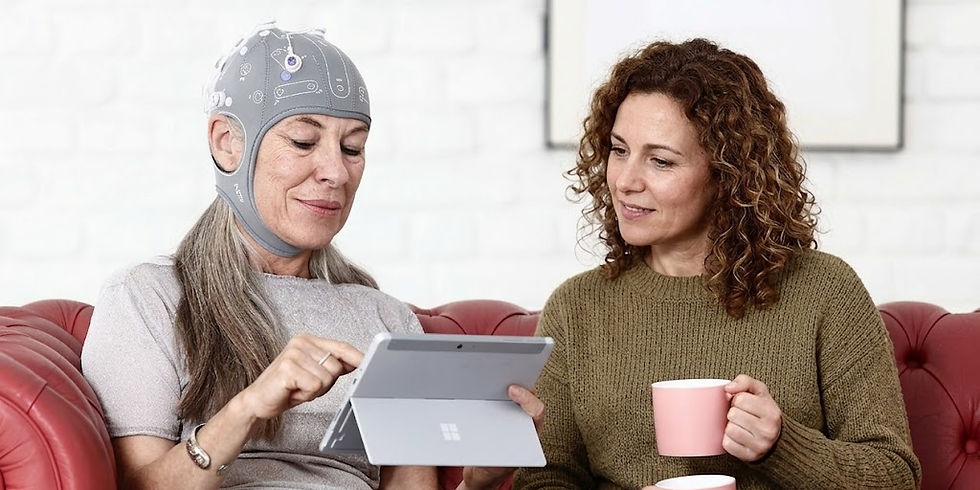
Transcranial alternating current stimulation (tACS) is a non-invasive brain stimulation technique that uses mild electrical currents to modulate brain activity and neural oscillations. Traditionally, this therapy required repeated visits to specialized clinics.
Today, advancements in telemedicine and wearable neurotechnology allow tACS to be delivered safely at home—with caregivers playing a central role in treatment administration.
According to the study, patients received:
20 sessions over 4 weeks
Each session lasting 20 minutes
Real-time remote supervision by clinicians
This model combines clinical-grade precision with the convenience of home-based care, enabling consistent, high-frequency treatment delivery.
A key limitation of neuromodulation therapies has historically been treatment accessibility, as effective protocols require repeated sessions in controlled environments. The study by Bouhour et al. (2026) demonstrates that this barrier can be overcome through structured caregiver training and remote clinical oversight.
Why Home-Based Brain Stimulation Delivery Matters
For clinicians, one of the biggest challenges in managing MCI is ensuring continuity of care and treatment adherence. Frequent clinic visits can be impractical for older adults due to:
Mobility limitations
Caregiver availability
Geographic constraints
Home-based brain stimulation offers a decentralized, patient-centered care model, enabling:
High-frequency therapy in real-world settings
Reduced burden on healthcare systems
Greater accessibility for aging populations
By shifting treatment into the home, tACS enables consistent daily therapy in a familiar and supportive environment—a key factor in long-term cognitive care.
Key Findings from the Study
1. Caregivers Can Successfully Deliver Therapy
85–100% confidence across technical tasks
Most caregivers achieved confidence within 2–3 sessions
Older caregivers (average age ~70) performed effectively
These findings demonstrate that non-professional caregivers can safely administer advanced neuromodulation therapies with appropriate training.
2. High Satisfaction and Acceptance
90% of caregivers were satisfied with training
95% of patients reported satisfaction
85% of caregivers would use the system again
Despite technical complexity, the system proved user-friendly, acceptable, and scalable across households.
3. Daily Life Impact Is the Primary Barrier
70% of caregivers reported disruption to daily routines
Scheduling sessions was feasible—but demanding
This highlights a critical implementation insight:
👉 The technology is effective—but integration into daily life requires optimization.
4. Mixed but Clinically Meaningful Outcomes
45% of caregivers observed improvement
57% of patients perceived benefits
Most reported stable cognition rather than significant improvement
In the context of MCI, this is clinically important—slowing or stabilizing cognitive decline is often considered a positive therapeutic outcome.
How Training and Remote Supervision Enable Safe Use
Caregivers underwent structured, competency-based training that included:
Observing clinical sessions
Hands-on practice under supervision
Demonstrating full procedural competency
Once trained, caregivers administered therapy at home while clinicians remotely monitored:
Device performance
Safety parameters
Session completion and adherence
This hybrid care model ensures both clinical safety and caregiver autonomy, making home-based neuromodulation viable at scale.
The Future of At-Home Neurological Care
This study represents a major step toward decentralized and digitally enabled healthcare. Imagine a future where:
Cognitive therapies are delivered daily at home
Caregivers become active participants in treatment
AI-guided systems assist with setup and troubleshooting
The research even suggests future improvements like:
Smarter interfaces
Flexible scheduling
AI-driven support systems
Together, these advancements could make home-based brain stimulation a standard approach in cognitive care.
Final Thoughts: A New Era in Caregiving and Brain Health
Home-based tACS represents a powerful convergence of clinical neuroscience, digital health, and caregiver empowerment.
For clinicians, it provides a pathway to extend evidence-based care beyond traditional clinical settings.
For caregivers, it offers a structured and meaningful role in supporting treatment and recovery.
By combining technology with human-centered care, we can:
Expand access to cognitive therapies
Reduce healthcare system burden
Improve quality of life for patients and families
While challenges such as daily life integration remain, the potential of home-based brain stimulation for mild cognitive impairment is substantial—and only beginning to be realized.
Explore What’s Next
As healthcare continues to evolve toward home-based, technology-driven solutions, innovations like brain stimulation are leading the way. Explore our latest range of smart health devices designed to support clinicians and caregivers in delivering safe, effective, and accessible care directly at home.
References
Bouhour, C. et al. (2026). Family caregiver perspectives on administering home-based stimulation in patients with mild cognitive impairment. Journal of Alzheimer’s Disease. https://pubmed.ncbi.nlm.nih.gov/41834385/
Antal, A., & Paulus, W. (2013). Transcranial alternating current stimulation (tACS). https://pubmed.ncbi.nlm.nih.gov/23825454/
Grover, S. et al. (2023). tACS and cognitive improvement meta-analysis. https://pubmed.ncbi.nlm.nih.gov/37224229/
Bréchet, L. et al. (2021). Home-based brain stimulation for Alzheimer’s disease. https://pubmed.ncbi.nlm.nih.gov/34093384/


Comments